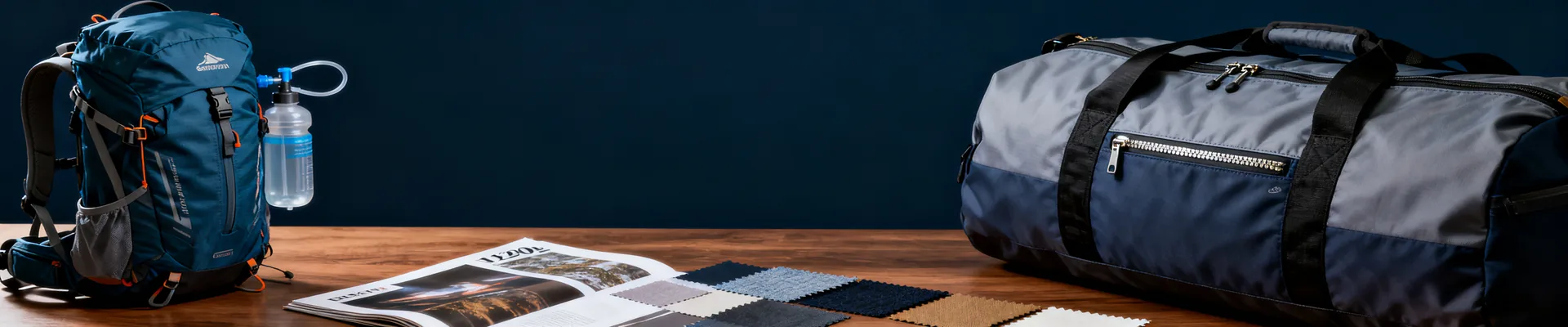
The call came on September 26, 2023, at 4:12 p.m. A regional distributor needed an event kit for an enduro race on October 14: Leatt AirFlex knee pads, custom duffel bags with their logo, cooler bags for team kits, and a small run of travel backpacks for resale.
I had handled B2B orders for seven years. I had made — and documented — 11 significant mistakes, totaling roughly $12,000 in wasted budget. I kept a checklist for exactly this kind of order. Did I use it that afternoon? Partially. That was the problem.
The order that looked simple
On paper, the order was straightforward. The distributor had run a similar kit the year before. They gave me quantities, a logo file, and a deadline. I confirmed the Leatt knee pads from stock, sent the bag requirements to our OEM duffel bag factory, and asked for cooler bag options.
I said yes to the October 14 date. That was mistake number one.
Not because the date was impossible. Because I said yes before I had written down what 'yes' actually required. In my first year, 2017, I made the classic error of treating a purchase order as a conversation. A conversation can stay vague. A PO cannot.
Where the assumptions started
Mistake 1: The knee pad size curve
The Leatt AirFlex knee pads were the easy part — or so I thought. The AirFlex impact gel and ventilated sleeve are designed to balance pedaling comfort with coverage. Fit matters. Size curve matters more.
The distributor said, 'send your standard run.' I pulled our usual split: 20% small, 35% medium, 30% large, 15% XL. That split works for a general retail store. An enduro race crowd is not a general retail store. More gravity riders, more knee braces, more bigger frames.
We sold out of XL by 10 a.m. on day one of the event. Not because we had too few knee pads overall. Because we had the wrong mix. The fix cost us $420 in transfer fees from another warehouse and two days of freight. Annoying, but recoverable.
The lesson was not 'order more XL.' It was: ask what the event crowd looks like before you copy last year's size curve. Most buyers focus on total units and completely miss the size distribution. I was one of them.
Mistake 2: 'Race day' is not a cooler bag specification
This one still bothers me. The distributor asked for cooler bags that could handle 'a race day.' I wrote that phrase into the request. The factory quoted a standard insulated bag with 4mm PE foam. The price was good. I approved the sample.
Then we ran our own test in late September 2023. Nothing fancy: 32°C ambient temperature, 2:1 ice-to-water ratio, eight cans. The 4mm PE foam sample hit 12°C at the six-hour mark. The 8mm EVA with a TPU liner stayed under 8°C for 10 hours. That is the difference between a race day and a lunch break.
What does 'race day' actually mean? For a team buying a cooler bag at 7 a.m. and opening it at 3 p.m., it means 8 to 10 hours of hold time in heat. I never defined it. The factory never asked. We both used the same words and meant different things.
If a cooler bag specification does not include foam thickness, liner material, ice ratio, ambient temperature, and test duration, it is not a specification. It is a hope.
Mistake 3: OEM duffel bags and the word 'water-resistant'
For the duffel bag OEM run, I wrote 'water-resistant' on the spec sheet. The factory read 'standard zipper.' Result: a duffel bag that shed light rain for about three minutes and then soaked through the seam.
I said water-resistant. They heard standard zipper. We were using the same phrase but meaning different things. I discovered it when the pre-production sample arrived and I ran it under a tap for 60 seconds. The inside was wet.
To be fair, the FOB price was competitive. That is exactly why the mistake was easy to make. A good price on the wrong specification is not a good price. It is a redo waiting to happen.
For reference, based on three written OEM quotes we collected in August 2023 for 500 custom 600D polyester duffel bags with a one-color logo, FOB pricing ranged from $8.90 to $12.40 per unit. Air freight for about 180 kg was quoted at $1,150 to $1,600. Duties and brokerage added another 6% to 11%, depending on destination. Those are dated numbers. Get current quotes.
Mistake 4: The travel backpack wholesale cost guide I skipped
The distributor also wanted a small run of travel backpacks for resale. I gave them a wholesale cost estimate based on FOB. That was incomplete.
A basic travel backpack wholesale cost guide should include: FOB unit price, freight, duty, brokerage, logo setup, inspection costs, payment fees, and the cost of any pre-production samples. For a 28L pack in 600D polyester with a padded sleeve and branded zippers, 2023 quotes at 500 units ranged from $14.50 to $22.00 FOB. After freight, duty, and logo setup, landed cost was 28% to 41% higher than the FOB number.
That gap is the guide. The FOB price is the starting line, not the finish line.
The 17-day warning
On October 2, we had 12 days until the event. The factory sent a video of the cooler bag first article. The ice test failed. The duffel bag sample leaked at the seam. The travel backpack landed cost was 37% above what the distributor had budgeted.
And the warehouse told me we were short on XL Leatt knee pads.
Four problems, one deadline. I remember standing in the warehouse aisle thinking, 'This is the order where I finally get fired.'
We had two options. Ship the flawed bags and hope the distributor did not notice until after the event. Or pay for expedited production and air freight with a confirmed ship date.
The flawed option was cheaper. It was also the kind of cheap that costs more later.
The decision: pay for certainty
On October 3, we paid $1,850 for expedited production and air freight. That covered redoing the cooler bag liner and zipper, plus moving the corrected duffel bags and backpacks on a confirmed flight. We also paid $420 to transfer XL knee pads from another warehouse.
Total rush spend: $2,270.
The fee did not buy speed, exactly. It bought a date. A confirmed ship date, in writing, before we committed the final PO. The cheaper option might have worked. 'Might' was the problem.
In March 2024, we paid $400 extra for rush delivery on a different order. The alternative was missing a $15,000 event. That felt expensive at the time. It was not. The math was obvious after the fact. It is always obvious after the fact.
What the event actually cost (and saved)
The kit landed on October 12. The event was October 14. We sold about $14,000 at the event and wrote $6,800 in follow-up wholesale orders over the next six weeks. The rush fee was 13% of event revenue. Missing the event would have cost us an estimated $9,500 in on-site sales, plus the credibility hit with a distributor who had already told 40 dealers we would be there.
The XL knee pads sold through by Saturday afternoon. The reworked cooler bags passed the 10-hour test. The duffel bags stopped leaking after the seam tape was added. The distributor reordered in January.
I kept the failed cooler bag sample on my desk for a year. It was a reminder that 'race day' is not a specification.
The checklist I use now
We have caught 47 potential errors using this checklist in the past 18 months. Here is the short version.
- Size curve by event type, not store average. Ask who is actually buying. Enduro, downhill, trail, and commuter crowds do not need the same mix.
- Cooler bag specification sheet with numbers. Foam thickness, liner material, ice-to-water ratio, ambient temperature, and test duration. No numbers, no approval.
- Duffel bag OEM pre-production sample signed off in writing. Zipper type, fabric denier, seam sealing, logo placement, and a 60-second water test.
- Travel backpack landed cost, not FOB. Freight, duty, brokerage, logo setup, inspection, and payment fees. If the number looks too good, a cost is missing.
- Confirmed ship date before the PO. If a supplier cannot give a date, treat that as a warning, not a negotiation tactic.
- Rush budget line. If the deadline is fixed, price the certainty option before you need it.
The cheapest quote is rarely the cheapest order. The fastest promise is rarely the most certain one. And 'race day' is not a specification. Write it down.

Jane Smith
I’m Jane Smith, a senior content writer with over 15 years of experience in the packaging and printing industry. I specialize in writing about the latest trends, technologies, and best practices in packaging design, sustainability, and printing techniques. My goal is to help businesses understand complex printing processes and design solutions that enhance both product packaging and brand visibility.